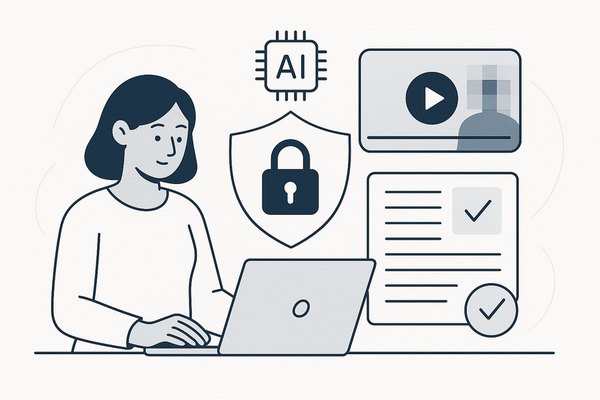
Understanding AI Video Clip Encryption: The Future of Secure Digital Content
Explore how AI video clip encryption provides adaptive security to digital videos, combating piracy and enhancing content protection for a secure online experience.


8 min read
Key Takeaways
- Adaptive Security: Merges machine learning with AES protocols for real-time video protection.
- Proactive Defense: AI-driven threat analysis, automated key management, and dynamic encryption adjustments.
- End-to-End Protection: Secures video at rest, in transit, and during playback to prevent piracy.
- Trade-Offs: Requires significant compute resources, specialized expertise, and attention to privacy.
- Future Outlook: Trends include quantum-ready encryption, federated learning, blockchain, and edge AI solutions.
Table of Contents
- Why It Matters
- Background on AI Video Clip Encryption
- The Role of AI in Enhancing Video Clip Encryption
- Benefits of AI Video Clip Encryption
- Challenges and Considerations
- Future Trends and Innovations
- Conclusion
Why It Matters
**Video piracy** is a growing menace: over 80% of global online piracy stems from illegal streaming, and 83% of enterprises say robust video security drives their buying decisions. For creators seeking a secure way to extract and repurpose encrypted video moments, Vidulk - AI Video Clipping App offers a seamless, AI-driven workflow to clip and share your protected content.
- Over 80% of global online piracy is due to illegal streaming.
- 83% of enterprises say video security drives buying decisions.
Background on AI Video Clip Encryption
Encryption Fundamentals
Encryption converts readable video into scrambled data that only authorized users can decode.
- Uses algorithms like AES (Advanced Encryption Standard)
- Splits clips into segments and encrypts each one separately
Critical Role in Digital Media
Comprehensive video security must address all stages:
- At rest (secure storage)
- In transit (secure transfer)
- During playback (authorized viewing)
Common Challenges Without AI
- Unauthorized access and piracy
- Illegal copying and distribution
- Intellectual property violations
- Revenue losses and brand damage
- Loss of distribution control
Evolution to AI-Driven Approaches
- Traditional: Static AES encryption, manual key updates
- AI-Driven: Dynamic defense that learns from threats and adapts encryption strength
The Role of AI in Enhancing Video Clip Encryption
Overview of AI Integration
- Key generation & management
- Video segmentation & encryption
- Secure delivery
- Decryption & playback

Key Generation & Management
- AI generates strong cryptographic keys
- Automates key rotation schedules
- Secure storage with minimal human intervention
Video Data Encryption Process
- Segment video into fixed-size chunks
- Encrypt each chunk using AES-256
- AI monitors for irregular patterns during encryption
Secure Delivery
- Transmit encrypted segments over HTTPS
- AI analyzes network traffic for anomalies
- Flags and halts suspicious transfers
Decryption & Playback
- Authorized players decrypt in real time
- AI verifies user credentials before granting access
- Detects and blocks unauthorized playback attempts
Specific AI Techniques
- Pattern recognition to spot brute-force attempts
- Anomaly detection for unusual user behavior
- Adaptive protocols that adjust encryption strength on the fly
AI-Based vs. Traditional Encryption
- Threat Response: Static vs. dynamic
- Evolution: Fixed vs. continuous learning
- Efficiency: Manual vs. automated
- Key Management: Human vs. AI-assisted
- Vulnerability Detection: Reactive vs. proactive
- Adaptation Speed: Slow vs. immediate
Benefits of AI Video Clip Encryption
Improved Security Measures & Threat Detection
- Real-time threat analysis stops attacks early
- Continuous learning strengthens defense over time
- Blocks evolving attack vectors static systems miss
Enhanced Speed & Efficiency
- Automated key management reduces human error
- Optimized segmentation and encryption pipelines
- Intelligent resource allocation speeds processing
Dynamic Adjustment to Evolving Cyber Threats
- AI auto-tunes algorithms for new threat types
- Predictive measures forecast and block vulnerabilities
- No manual updates needed for emerging threats
Real-World Applications & Case Studies
- Enterprise training: Cloudinary’s adaptive AI encryption
- Streaming platforms: Castr’s AI solution preventing live-stream piracy
- Compliance: GDPR and HIPAA privacy via end-to-end AI encryption
- Subscription services: Smart key checks to prevent password sharing
Challenges and Considerations
Computational Resource Requirements
- Real-time ML inference demands high CPU/GPU power
- Scaling hurdles for smaller organizations
Cost Implications
- Upfront investment in AI hardware/software
- Ongoing model training and update expenses
- Complex ROI calculations for SMEs
Technical Expertise Requirements
- Need for AI and cryptography specialists
- Talent shortages slow adoption
- Time and budget needed for upskilling
Data Privacy & Ethics
- User behavior analytics may raise surveillance concerns
- Must comply with GDPR and other regulations
- Avoid bias and false positives that lock out legitimate users
Future Trends and Innovations
Emerging Trends
- Quantum-ready AI encryption for post-quantum security
- Federated learning trains models without centralizing data
- Blockchain for immutable logs and decentralized key management
- Edge AI encryption for on-device protection and low latency
Potential Breakthroughs
- Zero-trust architectures with continuous user verification
- Homomorphic encryption to compute on encrypted data
- Neuromorphic hardware for energy-efficient encryption
- Self-healing systems that recover automatically from attacks
Industry Evolution Predictions
- Autonomous security systems requiring minimal oversight
- AI-powered threat intelligence networks sharing real-time insights
- Personalized encryption based on user risk profiles
- Invisible security that never interrupts the viewing experience
Conclusion
AI video clip encryption fuses machine learning with proven AES standards to deliver adaptive, intelligent security for digital videos. This approach provides:
- Proactive threat detection
- Automation-driven efficiency gains
- Dynamic responses to novel attack methods
Implementation roadmap:
- Assess your video security requirements
- Budget for AI infrastructure and specialized expertise
- Pilot AI encryption on non-critical content
- Monitor evolving threats, update models, and ensure privacy compliance
Stay informed to protect your content, meet regulations, and deliver a seamless, secure viewing experience.
FAQ
- What is AI video clip encryption?
- It’s a method that combines machine learning with AES-based encryption to adaptively secure video content at every stage: storage, transfer, and playback.
- How does AI improve video encryption?
- AI provides real-time threat detection, automates key management, learns from attack patterns, and dynamically adjusts encryption strength.
- Can small creators adopt AI video encryption?
- Yes—cloud-based services and scalable solutions lower the barrier to entry, though considerations around cost and expertise remain.