Understanding Deepfake Chat Video Voiceover Technology
Explore deepfake chat video voiceover technology, including AI/ML techniques, applications, and ethical insights. Learn how synthetic media is reshaping industries.

Estimated reading time: 10 minutes
Key Takeaways
- Deepfake chat video voiceover leverages AI to generate convincing fake dialogues, videos, and voice recordings.
- Core technologies include Generative Adversarial Networks (GANs) and autoencoders for face swaps and audio cloning.
- The typical workflow spans data collection, model training, content generation, and manual refinement.
- Applications range from chat interfaces and video manipulation to voice cloning for film dubbing and gaming.
- Significant ethical, legal, and security considerations arise around misinformation, consent, and detection.
Table of Contents
- Introduction
- Understanding Deepfake Technology
- Deepfake in Chat, Video, and Voiceover Applications
- Technical Process and Tools
- Use Cases and Practical Examples
- Ethical, Legal, and Security Considerations
- Future Trends and Industry Outlook
- FAQ
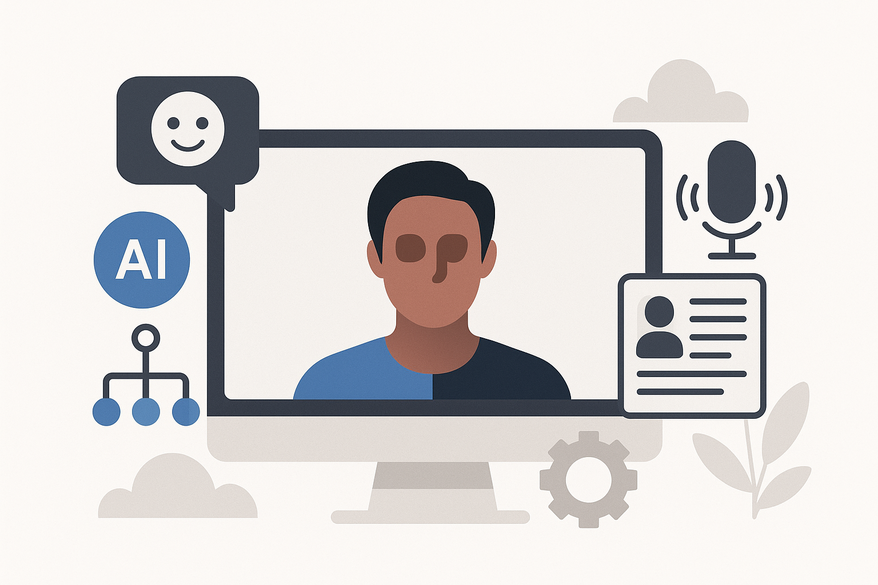
Deepfake chat video voiceover refers to the use of artificial intelligence (AI)-generated synthetic media to fabricate or manipulate chat conversations, videos, and voice recordings so they appear realistic. This technology relies on deep neural networks and machine learning models to create convincing fake dialogues, swap faces in video footage, or clone voices without human involvement.
Tools like Vidulk - Fake Text Message Story App simplify the creation of realistic chat scenarios and integrated voiceovers with minimal manual editing.
Understanding Deepfake Technology
What Is a Deepfake?
A deepfake is synthetically generated or altered content—images, video, or audio—produced using AI, particularly deep neural networks. These manipulated media assets can show people saying or doing things they never did. The term combines “deep learning” with “fake,” underlining its reliance on AI for creating realistic forgeries (sources: Proofpoint, TechTarget).
- Deep neural networks learn features like facial expressions or vocal patterns.
- Outputs can include face swaps in videos or completely fabricated dialogues.
- Use cases range from harmless entertainment to malicious misinformation.
Core Technologies: GANs and Autoencoders
Generative Adversarial Networks (GANs):
- GANs consist of a generator that creates synthetic samples and a discriminator that evaluates realism.
- Through iterative training, the generator learns to fool the discriminator, producing highly realistic outputs (source: CrowdStrike).
Autoencoders for Face Swap:
- Autoencoders encode input images into compressed representations and decode them into new outputs.
- They learn how facial features map into latent spaces and reconstruct swapped faces.
- Commonly used in consumer tools for swapping faces in video clips.
History & Evolution
Since their emergence around 2017, deepfakes have evolved from simple face swaps in memes to high-fidelity video and audio forgeries. Open-source platforms like FaceSwap and DeepFaceLab made the technology accessible, while concurrent research produced forensic tools for detection (source: Wikipedia).
Deepfake in Chat, Video, and Voiceover Applications
Deepfake in Chat Interfaces
Deepfake chat combines natural language processing (NLP), text-to-speech, and voice cloning to simulate human conversation:
- AI-driven chatbots analyze prompts and generate contextually relevant replies.
- Cloned voices of celebrities or brand spokespeople add familiarity.
- Facial animations in video chat windows can sync to the cloned voice.
Example: A customer service bot answers inquiries in a brand ambassador’s voice, improving engagement and trust.
Deepfake Video Manipulation
Video deepfakes train on hundreds of hours of target footage to model facial expressions, head movements, and color profiles. Key steps include:
- Data gathering: large datasets of target faces under varied lighting and angles.
- Model training: GANs refine realism across features like skin texture and eye movement.
- Face swapping and post-processing: color grading, artifact removal, lip-sync correction.
Example: A virtual spokesperson delivers product updates without the real person on set, reducing costs and speeding production.
Deepfake Voiceover Generation
Voice cloning uses AI to analyze pitch, cadence, accent, and timbre from audio samples. The process includes:
- Recording clean audio samples of the speaker.
- Extracting vocal features via neural network encoders.
- Synthesizing new speech in the speaker’s voice using decoder networks.
Use cases include film dubbing, game NPCs, and virtual assistants adopting recognizable voices.
Technical Process and Tools
Step-by-Step Workflow
- Data Collection: Gather diverse images, videos, and audio samples of the target.
- Model Training: Use GANs for image/video or autoencoders for face swaps; leverage GPU clusters.
- Content Generation: Integrate NLP and TTS for chat; apply GANs to produce video frames; decode text into speech.
- Refinement: Measure perceptual loss and audio SNR; perform manual frame corrections and lip-sync alignment.
Popular Tools & Methodologies
- GAN Frameworks: TensorFlow, PyTorch, NVIDIA StyleGAN.
- Autoencoder Platforms: FaceSwap, DeepFaceLab.
- Voice Cloning Software: Descript Overdub, Resemble AI.
- Audio-Video Sync: Wav2Lip for perfect lip-sync alignment.
Use Cases and Practical Examples
Chat Applications
- Customer service bots with cloned voiceovers available 24/7.
- Virtual influencers interacting with fans via text and voice.
Video Production
- Advertising: hyper-realistic video ads starring virtual spokespeople.
- Content creation: historical reenactments, parody, and satire.
Voiceover Technology
- Film dubbing with native actor’s voice clones.
- Gaming NPCs with consistent, scalable character voices.
- VR narration adopting authoritative or friendly tones.
Ethical, Legal, and Security Considerations
Ethical Implications
Deepfakes enable misinformation, non-consensual likeness use, and political manipulation (source: Brookings).
Privacy & Consent
Unauthorized deepfakes violate privacy and may cause emotional distress. Informed consent and psychological impact are central concerns (source: Wikipedia).
Legal & Security Frameworks
Detection tools, digital watermarking, and emerging international laws aim to curb misuse, though enforcement often lags behind technological advances.
Future Trends and Industry Outlook
Emerging Trends
Expect 4K-resolution fakes, real-time synthesis, and integrated detection systems blurring the lines between genuine and synthetic media.
Industry Impact
Deepfake chat video voiceover technology will transform entertainment, education, and customer service. Striking a balance between innovation and ethical safeguards is critical.
FAQ
- What is deepfake chat video voiceover?
It is AI-powered synthetic media that fabricates or alters chat conversations, videos, and audio to appear authentic. - Which technologies power deepfakes?
Generative Adversarial Networks (GANs) and autoencoders are the core frameworks for creating realistic face swaps and voice clones. - How can one detect a deepfake?
Detection methods include forensic analysis, AI-based classifiers, and digital watermarking standards to verify media authenticity.