The Ultimate Guide to AI Facial Recognition Clip Tool
Explore the technology, use cases, and best practices of AI facial recognition clip tool, providing insights into security, retail, and healthcare applications.

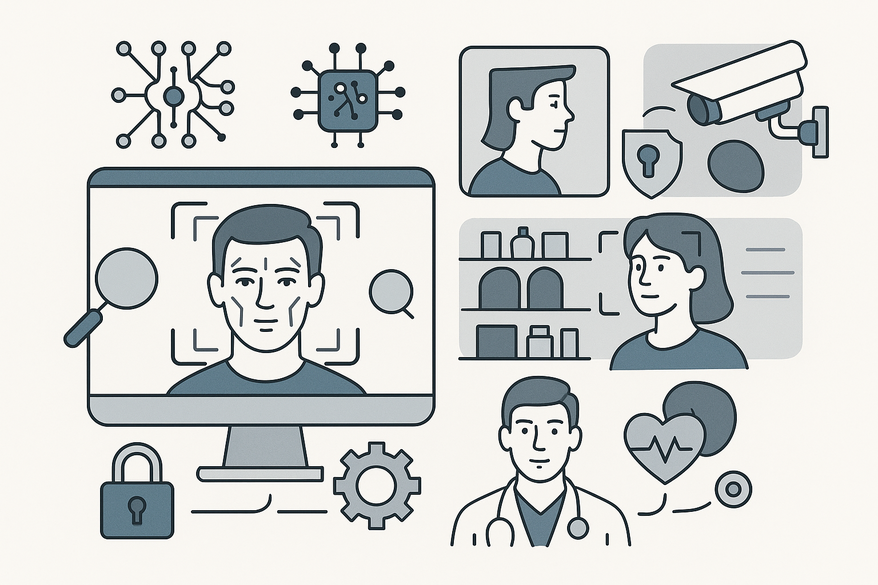
Estimated reading time: 8 minutes
Key Takeaways
- AI Facial Recognition Clip Tools combine computer vision and machine learning to detect and extract faces.
- Step-by-Step Workflow spans detection, feature extraction, encoding, and matching.
- Diverse Applications include security, retail analytics, device authentication, and healthcare.
- Advantages vs. Limits such as real-time accuracy against privacy and bias concerns.
- Ethical Best Practices stress consent, transparency, and regulatory compliance.
- Future Trends point to 3D recognition, multimodal biometrics, and on-device processing.
Table of Contents
- 1. Definition and Explanation
- 2. How It Works
- 3. Applications and Use Cases
- 4. Benefits and Limitations
- 5. Ethical and Privacy Considerations
- 6. Future Outlook
- Conclusion
1. Definition and Explanation: AI facial recognition clip tool
AI facial recognition clip tool is a sophisticated convergence of artificial intelligence and biometric software designed to isolate, analyze, and verify faces in images and video clips. This technology combines machine learning, computer vision, and pattern-matching to detect and match faces accurately. Today, these systems power real-time security, contactless authentication, and analytics across industries—from law enforcement and retail to healthcare and smart devices.

What is AI facial recognition?
- Uses machine learning and computer vision to confirm identities by analyzing unique facial features.
- AI models train on millions of examples to differentiate subtle patterns.
What are clip tools?
- Software modules that crop and standardize faces from busy backgrounds.
- Prepare uniform inputs for recognition engines by normalizing resolution, lighting, and angle.
Core Technology Architecture
- Computer Vision: Face localization using object-detection models.
- Machine Learning: Adaptive training to handle lighting, pose, and expression.
- Artificial Intelligence: Pattern recognition learned from vast data.
Dataset Sourcing and Scale
- Public image repositories and social media platforms supply thousands to billions of faces.
- Diverse datasets ensure broad population generalization.
2. How AI facial recognition clip tool Works
This section describes the end-to-end workflow from raw video input to identity match.
Step-by-Step Workflow
- Face Detection
- Uses CNN detectors to locate bounding boxes around faces. - Feature Extraction
- Measures distances and contours of facial landmarks. - Facial Encoding
- Converts landmarks into a numerical template for comparison. - Matching & Authentication
- One-to-one verification and one-to-many identification against databases.
Role of Clip Tools
- Isolate and crop facial regions for cleaner inputs.
- Batch-process multiple clips to scale up analysis.
- Enable temporal tracking across video sequences.
By separating face extraction from recognition, clip tools reduce computation and boost accuracy in challenging footage.
3. Applications and Use Cases
These tools transform raw streams into actionable identity data across industries.
Security & Law Enforcement
- Real-time surveillance to identify suspects or missing persons.
- E-gate border control against passport databases.
- Surveillance accuracy up to 99.5% on standard datasets.
Retail & Commercial
- Customer behavior analytics for targeted marketing.
- Loss prevention by matching individuals across cameras.
Smart Devices & Consumer Technology
- Device unlock (e.g., Apple Face ID) with on-device inference.
- Smart home security to distinguish residents from intruders.
Healthcare & Accessibility
- Patient identification to combat medical identity fraud.
- Hands-free control for users with mobility impairments.
Enterprise & Content Management
- Employee access control for secure facilities.
- Automated tagging of brand ambassadors in media libraries.
4. Benefits and Limitations
Key Advantages
- Speed & Efficiency: Real-time ID across millions of faces.
- High Accuracy: Up to 99.5% on benchmarks.
- Contactless Authentication: Frictionless, post-pandemic friendly.
- Cost Reduction: Automates manual monitoring tasks.
Limitations & Challenges
- Privacy Concerns: Mass data collection without consent.
- Algorithmic Bias: Unequal performance among demographic groups.
- Misidentification Risks: False positives can have serious consequences.
- Data Security: Centralized databases vulnerable to breaches.
- Technical Limits: Struggles with disguises, aging, and low-light.
- Regulatory Uncertainty: Varies across GDPR, CCPA, BIPA.
5. Ethical and Privacy Considerations
These systems raise significant ethical questions. Adopting best practices is crucial.
Primary Ethical Concerns
- Consent & Transparency: Clear notification and opt-in processes.
- Surveillance & Autonomy: Risks of constant public monitoring.
- Behavioral Profiling: Unverified inferences on emotions or traits.
- Discrimination & Equity: Potential harm from biased outcomes.
Best Practices
- Data Minimization: Collect only what’s necessary.
- Explicit Consent: Clear opt-in/opt-out mechanisms.
- Transparency & Accountability: Public audits and reporting.
- Bias Mitigation: Diverse training sets and fairness tests.
- Regulatory Compliance: Align with GDPR, CCPA, BIPA, etc.
- Limited-Purpose Use: Restrict to defined, lawful scenarios.
6. Future Outlook
Emerging innovations will shape the next decade of clip-based recognition.
Emerging Trends
- 3D Recognition & Advanced Sensors for multi-angle precision.
- Multimodal Biometrics: Layered security combining face, iris, and voice.
- Edge Computing: On-device processing for privacy and speed.
- Privacy-Preserving ML: Federated learning and encryption.
Potential Sector Expansion
- Healthcare: Emotion-based mental health monitoring.
- Finance: Biometric verification for secure banking.
- Transportation: Driver monitoring in autonomous vehicles.
- Education: Attendance tracking with ethical guardrails.
- Smart Cities: Integrated surveillance with privacy safeguards.
Conclusion
AI facial recognition clip tools blend computer vision, machine learning, and biometric software to deliver fast and accurate face detection from video streams. In this guide, we’ve covered:
- Definitions and core architecture.
- End-to-end workflow and clip tool roles.
- Key industry applications and benefits.
- Limitations, ethical considerations, and best practices.
- Future trends in 3D, multimodal biometrics, and privacy technologies.
Balancing innovation with privacy, bias mitigation, and regulatory compliance is essential. The next wave of face-based intelligence depends on responsible governance and transparent practices.
For a simple on-device clipping solution, consider Vidulk - AI Video Clipping App for automatic extraction of key moments from your media files.
FAQ
- How accurate is this technology? Modern systems achieve up to 99.5% accuracy on standard datasets, though real-world performance varies.
- What privacy risks should I consider? Mass data collection, lack of consent, and database security are core concerns.
- Can these tools be biased? Yes. Models trained on non-diverse datasets can show unequal performance across demographic groups.
- How can I ensure ethical use? Implement data minimization, explicit consent, regular audits, and align with relevant laws (GDPR, CCPA, BIPA).