The Comprehensive Guide to Automatic Video Clip Keyword Tagging AI
Explore how automatic video clip keyword tagging AI enhances search accuracy, reduces costs and time, and improves SEO for video content management.

Estimated reading time: 10 minutes
Key Takeaways
- Multi-modal AI analyses visuals, audio, and text for rich metadata.
- Near real-time tagging reduces hours of manual work.
- Faster campaigns, better compliance, enhanced user experience, and lower costs.
- Phased rollout, hybrid human-AI review, and custom taxonomies are critical for successful deployment.
- Future trends include emotion tagging, real-time live tagging, semantic search, and privacy-preserving AI models.
Table of Contents
- Introduction
- The Technology Behind Automated Video Keyword Tagging
- Why Automated Video Keyword Tagging Beats Manual Methods
- Real-World Applications of AI-Driven Video Tagging
- How to Integrate Automatic Video Clip Keyword Tagging AI into Your Workflow
- What’s Next for Automated Video Keyword Tagging?
- Conclusion
1. Introduction
"automatic video clip keyword tagging AI" defines a machine-learning-powered system that analyzes a video’s visuals, audio, and on-screen text to generate descriptive metadata without human input. Also known as AI video tagging or automated video keyword tagging, this technology transforms disorganized video libraries into searchable, structured assets.
Approximately half of employees struggle to locate work content in video libraries, adding hours of wasted time to routine tasks, according to McKinsey Automation and the Future of Work.
- Time savings: hours per video reduced to minutes
- Scalability: process thousands of videos instantly
- Consistency: uniform metadata application
- Cost reduction: lower tagging expenses and improved ROI
This informational guide will explain the technology behind automatic video clip keyword tagging AI, explore its benefits and use cases, and provide actionable best practices for implementation.
2. The Technology Behind Automated Video Keyword Tagging
Automatic video clip keyword tagging AI relies on advanced AI video tagging technologies to interpret multimedia content. At its core, this auto-tagging approach combines several machine-learning components:
Core Components
- Computer Vision analyzes video frames to recognize objects (e.g., “dog,” “car”), scenes, and actions using convolutional neural networks (CNNs).
- Speech Recognition & Audio Analysis converts spoken words to text and identifies ambient sounds and music via RNNs or transformer models.
- Natural Language Processing (NLP) interprets transcripts for context and semantic meaning through tokenization and named-entity recognition.
- Contextual Intelligence fuses visual and audio insights to infer higher-order tags (e.g., “athlete scoring a goal”).
AI Algorithms and ML Models
- Deep Learning Models trained on millions of annotated frames achieve state-of-the-art accuracy (arXiv:1505.04597).
- Transfer Learning fine-tunes pre-trained services like Google Vision AI or Amazon Rekognition on custom datasets.
- Continuous Learning uses human feedback and engagement signals to refine tagging precision over time.
Step-by-Step Tagging Workflow
- Content Ingestion – Video upload to an automated tagging platform.
- Frame Extraction – Key frames sampled at adaptive intervals.
- Multi-Modal Analysis – Simultaneous processing of visuals, audio, and on-screen text.
- Contextual Processing – NLP engines infer relationships among detected elements.
- Tag Generation – System outputs keywords, entities, and themes.
- Metadata Assignment – Tags saved to the video file or integrated into a CMS.
For related insights into AI-driven clipping, see How AI Video Clipping Works: A Complete Guide to Automating Short-Form Content.
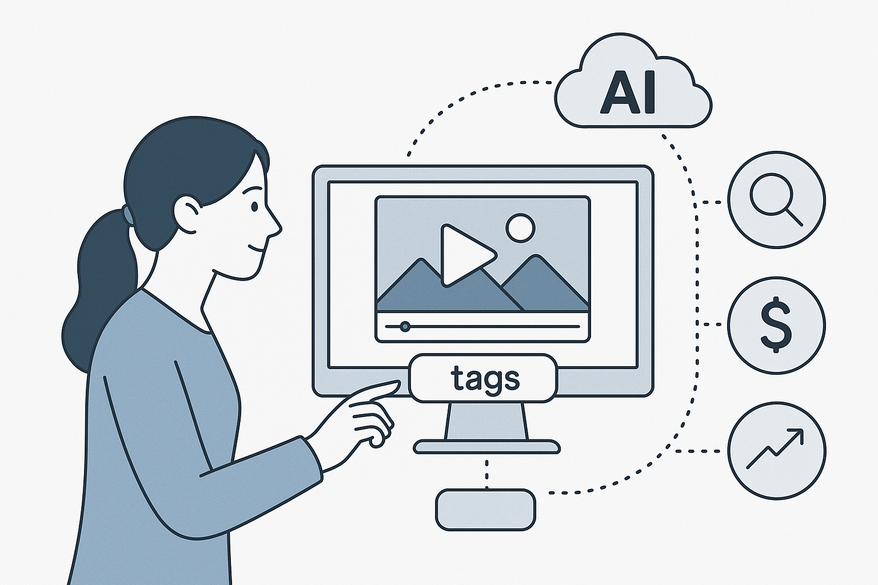
Visual Overview of Automated Tagging Workflow

3. Why Automated Video Keyword Tagging Beats Manual Methods
Automatic video clip keyword tagging AI outperforms traditional tagging through speed, consistency, and scale.
Time-Saving & Cost Reduction
- Manual: 15–30 minutes per video for skilled taggers.
- Automated: near real-time tagging during upload or in the background.
- Labor cost savings, eliminating dedicated tagging staff and reducing opportunity costs.
- Uniformity: AI applies consistent rules, avoiding human bias (Automation vs. Manual Tagging).
Improved Content Discoverability & SEO
- Enhanced search filters by topic, speaker, location, and emotion.
- Richer metadata boosts engine indexing and snippet appearances (Moz Video SEO Best Practices).
- Case example: a marketing team’s retrieval time dropped from 2 hours to seconds using AI tags.
Enhanced User Experience
- Personalized recommendations powered by precise tags.
- Reduced friction: viewers find relevant clips quickly.
- Cross-platform consistency on websites, portals, and apps.
4. Real-World Applications of AI-Driven Video Tagging
Automatic video clip keyword tagging AI powers solutions across industries, driving efficiency and innovation.
Media & Entertainment
Broadcasters index archives, accelerate promo creation, and improve recommendations—cutting retrieval time from hours to seconds and boosting promo production by 60% (case study).
Legal & Compliance
Law firms tag depositions by speaker and topic for rapid evidence discovery, ensuring subpoenas and deadlines are met (LawTech Journal).
Education
Universities auto-catalog lectures by topic and instructor, allowing students to find specific segments instantly and improve study efficiency.
E-Commerce & Marketing
Product demos and testimonials auto-tagged by features and benefits, enabling campaign libraries to be assembled in hours instead of weeks.
Corporate Training
Training modules tagged by competency and difficulty, helping HR track onboarding and compliance faster.
News & Journalism
Real-time tagging of breaking news by event and location, surfacing relevant clips for live broadcasts and digital publishing.
5. How to Integrate Automatic Video Clip Keyword Tagging AI into Your Workflow
A structured approach ensures successful adoption of automated video keyword tagging.
Phased Implementation
- Pilot with high-value libraries to validate accuracy.
- Review sample tags with stakeholders; refine AI models.
- Scale to legacy content once quality thresholds are met.
Hybrid Human-AI Model
AI handles baseline tagging; human editors review sensitive or brand-critical videos to balance efficiency with precision.
Custom Taxonomy Development
Define brand-specific vocabulary and train AI on these terms for relevant, consistent tagging.
SEO Metadata Optimization
Combine AI tags with SEO-rich titles and descriptions. Implement schema.org VideoObject markup to boost search visibility.
Multi-Language Tagging
Configure AI to generate tags in target audience languages, expanding global reach.
Overcoming Challenges
- Accuracy Improvement: Expect a 15–25% precision boost in 1–3 months via feedback loops.
- Privacy & Compliance: Use anonymization, GDPR/CCPA controls, and on-premise options.
- Integration Hurdles: Verify API compatibility with DAM/CMS platforms; budget for custom connectors.
- Avoid Over-Reliance: Schedule periodic audits and manual QA to maintain long-term accuracy.
6. What’s Next for Automated Video Keyword Tagging?
The future will deepen context awareness, real-time capabilities, and privacy protections:
- Emotion & Sentiment Recognition – Tag clips by emotional tone to enhance storytelling.
- Multi-Sensory & Immersive Analysis – AI will tag 360° and VR content as the metaverse grows.
- Real-Time Live Stream Tagging – Instant tagging of live events for faster workflows.
- Advanced Contextual Understanding – Recognize story arcs and sequences, not just discrete frames.
- Integration with Analytics & Personalization – Link tags to engagement metrics for predictive planning.
- Semantic Search Evolution – Support concept-based queries through nuanced metadata.
- Privacy-Preserving AI – On-device or federated learning tags videos without uploading sensitive content.
7. Conclusion
Automatic video clip keyword tagging AI is transforming video content management by combining computer vision, speech recognition, NLP, and contextual intelligence. Organizations achieve dramatic efficiency gains—retrieval times cut by up to 80%, manual tagging costs slashed, and metadata consistency guaranteed.
Tools like Vidulk - AI Video Clipping App can complement tagging by generating clips from the most relevant segments automatically and ensuring your metadata aligns with the best moments in your footage.
FAQ
- What is automatic video clip keyword tagging AI?
It’s a machine-learning system that analyzes visuals, audio, and text in videos to generate descriptive tags without human input.
- How does AI tagging improve productivity?
By reducing tagging time from tens of minutes to seconds, AI frees teams to focus on creative and strategic tasks.
- Which industries benefit most?
Media, legal, education, e-commerce, corporate training, and journalism all gain efficiency and discoverability.
- What are the key implementation steps?
Pilot with high-value content, develop custom taxonomies, adopt a hybrid human-AI model, and optimize SEO metadata.
- What future features can we expect?
Emotion tagging, real-time live stream analysis, semantic search, immersive VR tagging, and privacy-preserving AI.