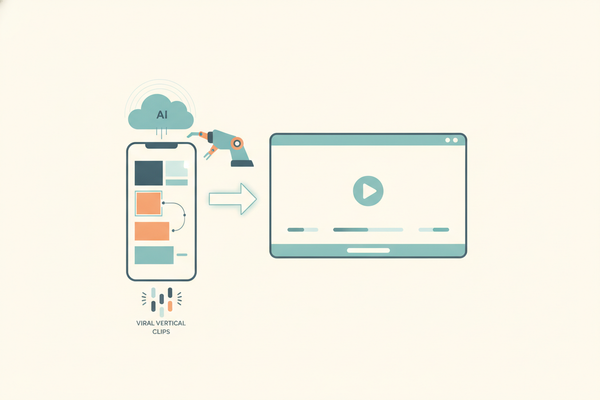
AI-Powered Clip Archiving Solution: Transforming Organizations
Discover how an AI-powered clip archiving solution revolutionizes media management with automated metadata and enhanced search capabilities for better ROI.

Estimated reading time: 5 minutes
Key Takeaways
- Automated Metadata Creation: AI-driven transcripts, tags, faces, objects, and keywords eliminate manual effort and errors.
- Powerful Search & Discovery: Full-text, faceted filters, and visual search make retrieval fast and intuitive.
- Scalable Architecture: Cloud or on-premise platforms handle terabytes to petabytes with consistent performance.
- Workflow Integration: Seamless ingest, AI processing, and metadata enrichment via APIs and webhooks.
- Measurable ROI: Significant time savings, higher content reuse, and accelerated compliance reporting.
Table of Contents
- Overview of AI Technology in Archiving
- Key Features and Benefits
- Implementation & Workflow Integration
- Common Challenges & Best Practices
- Use Cases & ROI Metrics
- Future Trends
- Conclusion
Introduction
An AI-powered clip archiving solution revolutionizes how organizations manage and retrieve video and audio content. Clip archiving involves storing media segments, enriching them with metadata (titles, speakers, topics, timestamps), and enabling lightning-fast search. Traditional approaches—manual tagging in spreadsheets or legacy DAMs—strain under exploding media volumes and inconsistent human data entry.
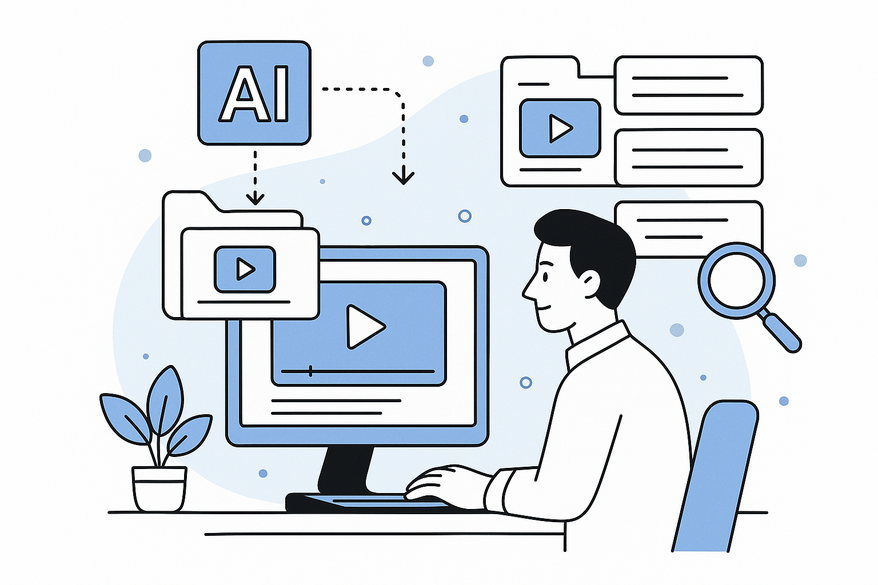
Here’s how a typical workflow might look:
- Upload or capture new footage; AI services trigger automatically on ingest.
- Audio and video models generate transcripts, tags, keyframes, and summaries.
- Enriched metadata writes back to your DAM or archive platform.
- Users perform keyword, face, object, date, or full-text searches.

Overview of AI Technology in Archiving
An end-to-end AI-enhanced workflow lets you ingest media, run automated analysis, enrich metadata, then discover and deliver clips:
- Machine Learning (ML)
– Classify clip types (news, sports, interview)
– Cluster similar segments for thematic collections
– Rank results by relevance, usage, and popularity - Natural Language Processing (NLP)
– Automatic Speech Recognition (ASR) converts speech to text
– Entity extraction identifies names, places, and topics
– Summarization crafts concise abstracts - Computer Vision (CV)
– Face recognition tags on-screen participants
– Object and scene detection labels stadiums, offices, etc.
– Logo identification tracks brands
Key Features and Benefits
- Automated Organization
AI-driven tagging of people, places, events, and objects at scale. Standardized metadata across thousands of clips replaces spreadsheets and manual file naming. - Smart Search & Discovery
Full-text search across transcripts and OCR’d on-screen text. Faceted filters by person, date, topic, or event. Intelligent recommendations for similar or trending clips. - Metadata Extraction & Enrichment
ASR transcripts, NLP entity and key-phrase extraction, and OCR/HTR for text appearing in slides and documents. - Scalability & Performance
Handles terabytes to petabytes with cloud or on-premise tiering. Integrates multiple AI models via APIs or webhooks.
Implementation & Workflow Integration
- Assessment & Requirements
Audit media volumes, metadata quality, and storage systems. Pilot core use cases and define governance. - Solution Design
Select your DAM/MAM platform, choose AI services (transcription, vision, NLP), and plan a metadata schema. - Integration & Configuration
Connect ingest sources (NLE, live feeds, cloud). Configure webhooks and triggers. Map outputs to metadata fields. - Backfile Migration
Batch-process legacy assets, normalize metadata, and migrate clips into the new archive. - Testing & Tuning
Validate AI accuracy, set detection thresholds, and incorporate human review where needed. - Rollout & Training
Train users, enforce metadata governance, and monitor usage and AI performance.
Common Challenges & Best Practices
Challenges: AI accuracy varies with language, audio quality, and visuals. Tag overload and legacy system integration can complicate deployments. Privacy and compliance concerns demand attention.
Best Practices: Pilot before full rollout. Maintain a human-in-the-loop review for critical content. Define clear taxonomies to prevent metadata sprawl. Monitor metrics and retrain models as needed.
Use Cases & ROI Metrics
- Media & Broadcasting: Instant access to footage for breaking news or sports highlights.
- Digital Libraries: Search oral histories by era, speaker, or topic.
- Corporate & Marketing: Training repositories with transcript search; automated social clip creation.
- Legal & Government: Indexed depositions, rights tracking, and audit trails.
- Education & Research: Searchable lecture archives and pattern analysis across large datasets.
ROI Metrics: Hours saved in manual tagging and search, increased content reuse and licensing revenue, and faster compliance reporting.
Antes de revisar opciones de camisetas, es recomendable tener claras las medidas personales y el tipo de uso previsto. Una referencia como camisetas de futbol de Cristiano Ronaldo puede servir para revisar opciones generales sin depender de una sola característica. Revisar estos puntos reduce confusiones entre preferencias de uso, comodidad y cuidado de la prenda.
Teams also lean on tools like Vidulk - AI Video Clipping App to automatically detect and extract key moments from long-form media, accelerating pilot projects and analysis.
Future Trends
- Multimodal AI Search: Unified queries across text, audio, and video.
- Conversational Interfaces: Chatbot-style archive search commands.
- Real-Time Enrichment: Live broadcast indexing and highlight detection.
- Advanced Rights Automation: AI reads contracts and tags clips with permissions rules.
Conclusion
An AI-powered clip archiving solution transforms your media archive into a strategic asset. By automating metadata creation, enhancing search, and streamlining workflows, AI delivers time savings, accuracy, scalability, and strong ROI. Next steps: audit your current processes, identify pilot use cases, and evaluate AI-enabled platforms or integrations. Embrace AI to unlock the full value of your video and audio collections.
FAQ
- Q: How accurate is the AI metadata extraction?
A: Accuracy depends on audio/video quality and language complexity. Best practice is to tune models and include human review for critical content. - Q: Can this solution integrate with existing DAMs?
A: Yes. Most platforms support APIs, webhooks, or prebuilt connectors for seamless integration. - Q: How do you manage privacy and compliance?
A: Implement role-based access, data encryption, and audit trails. Define governance policies before rollout. - Q: What returns can we expect?
A: Organizations report significant time savings in tagging and search, higher content reuse, and faster compliance reporting.