Batch Process Long Videos into Multiple Clips with AI Video Clipping
Learn how to batch process long videos into multiple clips using AI video clipping for podcasts, streams, and YouTube Shorts effortlessly.


Estimated reading time: 18 min
Key Takeaways
- Batch processing long videos into multiple clips saves time and boosts content reach by enabling rapid, large-scale repurposing for social media.
- AI-driven tools like Vidulk automatically detect best moments using advanced audio-visual analysis and transcript parsing, generating vertical, captioned clips optimized for engagement.
- Supports multiple input formats including MP4, MOV, audio files, and import sources such as local uploads, YouTube URLs, and cloud storage.
- Auto-captioning, aspect ratio conversion, and bulk export streamline repurposing workflows for TikTok, Reels, and Shorts, ensuring platform-specific optimization.
- Workflow presets and clip review features enable customization for diverse content types such as interviews, gameplay, webinars, and podcasts.
Table of Contents
- Section 1: Getting Started with Batch Video Clipping
- Section 2: AI Detection of Best Moments in Long Videos
- Section 3: Automatic Splitting and Formatting for Shorts
- Section 4: Supported Inputs, Formats, and Import Sources
- Section 5: Auto-Captioning, Titles, and Transcript-Based Clipping
- Section 6: Clip Review, Scoring, and Bulk Export Workflows
- Conclusion
- FAQ
Section 1: Getting Started with Batch Video Clipping
Understanding the Importance of Batch Processing
Batch processing long videos into multiple clips is a transformative approach for content creators aiming to maximize their reach across rapidly evolving social media platforms such as TikTok, Instagram Reels, and YouTube Shorts. These platforms reward frequent, engaging, and mobile-optimized content, making it essential to generate multiple short clips from longer videos efficiently.
Manual clipping of videos, especially those lasting an hour or more, can be labor-intensive and time-consuming. For example, a 90-minute podcast episode might require several hours of manual review to identify engaging segments, edit, caption, and format for vertical mobile viewing. Batch processing automates much of this workflow, drastically reducing time-to-publish and enabling creators to maintain a consistent content cadence.
By processing multiple videos simultaneously, batch clipping not only improves workflow efficiency but also ensures consistent output quality. This scalability is particularly beneficial for creators managing large video libraries or agencies handling multiple client accounts.
How to Clip a Podcast or Interview Efficiently
Podcasts and interviews typically feature long-form conversations with valuable insights dispersed across the timeline. The challenge lies in pinpointing these valuable moments and transforming them into engaging clips that resonate with social media audiences.
Using AI-powered tools like Vidulk, creators can upload full podcast episodes or interview recordings and rely on intelligent algorithms to detect moments with heightened emotional energy, keyword mentions, or topic shifts. For instance, an interview with a subject matter expert may have several distinct topics discussed; AI can segment these into thematic clips automatically.
Additionally, Vidulk's workflow presets allow users to tailor clip generation for interview formats — prioritizing speaker turns, removing dead air, and highlighting impactful statements. This customization reduces manual intervention, while still delivering polished clips optimized for platforms such as LinkedIn or Instagram.
By automating the extraction of 15-60 second clips, podcasters can multiply their content output from a single episode, increasing discoverability and listener engagement across channels.
Repurposing YouTube Videos into Shorts
With YouTube’s algorithm strongly favoring Shorts, repurposing existing long-form YouTube videos into short-form content is a strategic growth tactic. Batch processing tools enable creators to seamlessly transform a single 10-minute video into a series of vertical clips, each focusing on a key moment or engaging highlight.
Vidulk simplifies this by allowing users to upload YouTube video files or import directly via URL. Once imported, the AI identifies segments with high viewer retention potential — such as punchlines, surprising facts, or visually dynamic scenes — and automatically formats these for vertical viewing.
Creators can specify clip durations (e.g., 30 seconds) and use automatic cropping to preserve important visual content within the 9:16 aspect ratio. This ensures clips are optimized for mobile-first consumption without cropping out faces or key on-screen elements.
By efficiently generating multiple Shorts from existing videos, creators keep their content fresh, reach new audience segments, and increase overall channel engagement with minimal manual effort. For a detailed workflow on this process, see How to Turn Long Videos Into Short Clips: The Complete AI Workflow.
Section 2: AI Detection of Best Moments in Long Videos
How AI Identifies Highlight Moments
AI-driven video clipping relies on sophisticated algorithms that analyze both audio and visual data streams to detect segments likely to engage viewers. These algorithms incorporate several criteria:
- Audio cues: Detection of raised voice volume, tonal emphasis, laughter, or applause can indicate exciting or important moments.
- Visual changes: Scene transitions, facial expressions, zooms, or motion can highlight dynamic segments.
- Transcript analysis: Natural language processing (NLP) techniques analyze transcripts to identify keywords, important phrases, or thematic shifts.
- Engagement signals: In live streams, chat interaction spikes or viewer reactions can be factored in when available.
For example, in a lecture video, AI might detect when a professor raises their voice to emphasize a key point, or when a slide changes to a particularly informative graphic. In interviews, AI can identify moments where the guest shares anecdotes or impactful statements.
The combination of these signals allows the AI to determine clip boundaries — where to start and end each highlight — ensuring clips are coherent and contextually meaningful without manual trimming.
Benefits of AI-Powered Highlight Detection
- Efficiency: AI can process a 2-hour video in under 10 minutes, identifying dozens of highlight clips. This reduces manual review from hours to minutes.
- Consistency: AI applies uniform criteria across all videos, maintaining consistent clip length and quality, which is key for brand identity.
- Scalability: With batch processing, large archives of videos — potentially hundreds of hours — can be clipped automatically, enabling sustained content pipelines.
- Objectivity: AI reduces human bias by selecting clips based on data-driven engagement factors rather than subjective preferences.
Examples: Turning Streams and Lectures into Clips
Live streams often contain lengthy conversations, Q&A sessions, or gameplay that may be less engaging in long format but highly shareable in short clips. AI tools can segment such streams into bite-sized clips focusing on key plays, funny moments, or insightful commentary.
For instance, a 3-hour gaming stream can be automatically clipped into 50-100 short highlights — each 15-30 seconds long — capturing kills, funny fails, or strategic calls. These clips then serve as engaging content for TikTok or YouTube Shorts, vastly extending the stream's reach beyond the original live audience.
Similarly, academic lectures recorded for online courses can be clipped into digestible topic-specific videos. AI can detect slide changes, question-and-answer breaks, or emphasized points, producing clips that help students review material more efficiently.
Such automated segmentation accelerates educational content creation and distribution, improving learner engagement and retention.
Section 3: Automatic Splitting and Formatting for Shorts
How to Cut a Video into Shorts Seamlessly
After AI detects highlight moments, the next critical step is to split the video into clips that comply with platform requirements. Each social media platform has maximum duration limits — TikTok allows up to 10 minutes but favors clips around 15-60 seconds; Instagram Reels recently extended to 90 seconds; YouTube Shorts caps around 60 seconds.
Vidulk enables users to set preferred clip length ranges before processing. AI then adjusts clip boundaries accordingly, trimming excess footage while maintaining context integrity. For example, if a detected highlight is 90 seconds, Vidulk can divide it into two 45-second clips or trim it to a single 60-second clip based on user preference.
Automatic splitting also addresses natural pause points or sentence endings to avoid abrupt cuts, improving viewer experience. Users can further define minimum and maximum clip durations, ensuring content uniformity across batches.
Vertical Formatting and Aspect Ratio Conversion
Most short-form video platforms prioritize vertical video formats, typically 9:16 aspect ratio, optimized for smartphone screens. However, many original videos are recorded horizontally (16:9) or in square formats.
AI clipping apps like Vidulk implement intelligent cropping and resizing algorithms to convert horizontal videos into vertical clips without losing essential visual information. This includes:
- Face and object detection: The AI tracks key subjects (e.g., speakers’ faces) to keep them centered in the frame.
- Dynamic cropping: The crop window can pan or zoom subtly to follow action or maintain composition.
- Background filling: In some cases, blurred or stylized backgrounds fill the vertical frame beyond the cropped video to avoid black bars.
For example, a webinar recording showing two presenters side-by-side can be cropped into vertical clips focusing on one speaker at a time, making the content more engaging and focused for mobile viewers.
Creating Captioned Clips for Better Reach
Captions significantly increase video accessibility and engagement, especially on social media where videos autoplay silently by default. Studies show that videos with captions have up to 12% higher view time and 40% higher engagement rates.
Vidulk's AI-powered captioning automatically generates accurate transcripts, timing subtitles precisely with spoken words. Captions can be styled for readability with options for font, size, color, and positioning.
Moreover, captioned clips cater to hearing-impaired viewers and audiences in sound-off environments such as offices or public transport, broadening content reach.
Automatic caption generation also supports multiple languages, enabling creators to localize content for diverse audiences — a key growth factor for global channels.
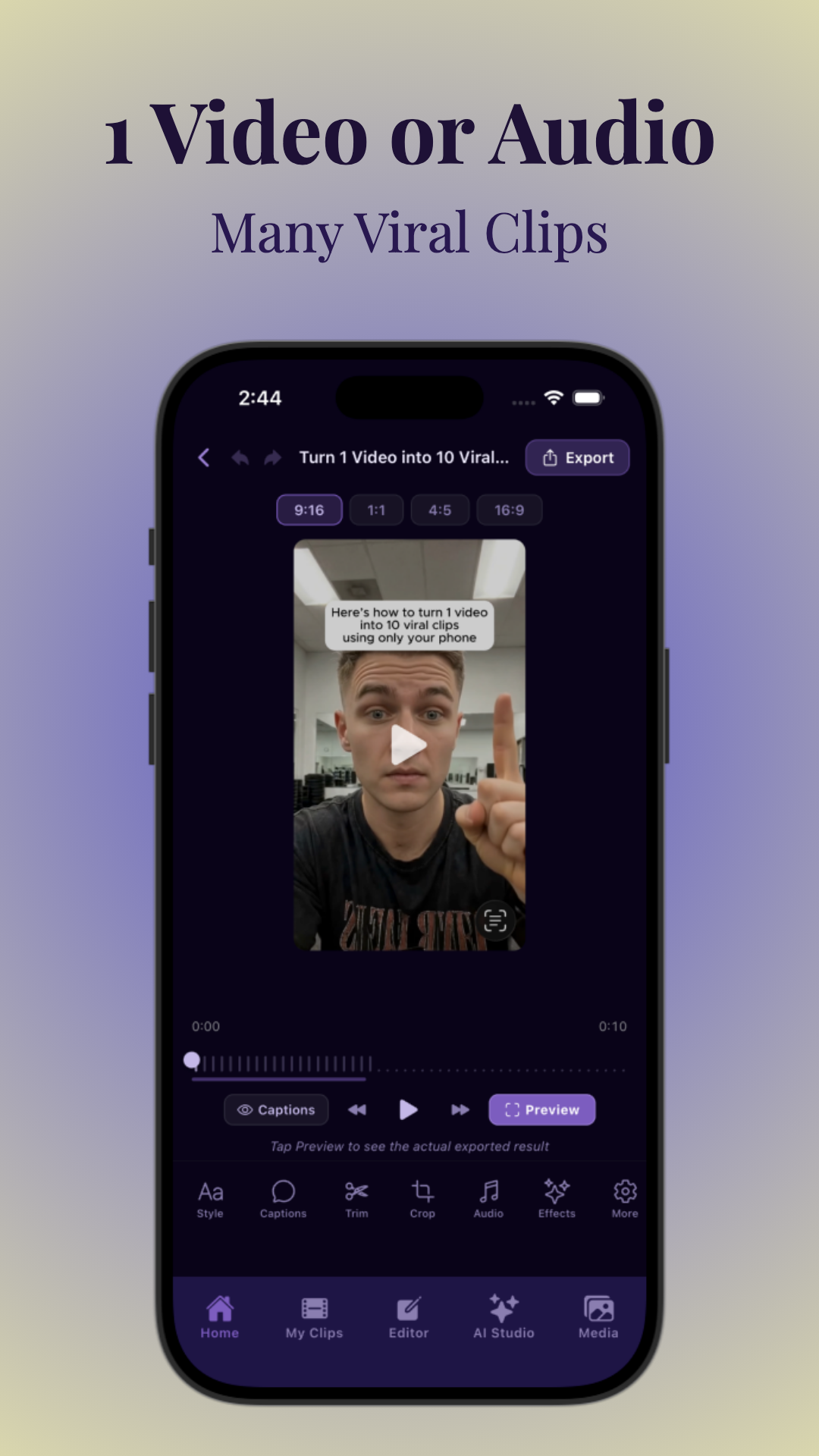
Section 4: Supported Inputs, Formats, and Import Sources
Batch Upload of Multiple Long Videos
For efficient content repurposing, batch upload capability is essential. Vidulk supports uploading dozens of long videos simultaneously through intuitive drag-and-drop interfaces or file selection dialogs.
Creators managing large content libraries benefit from this by avoiding repetitive upload steps. For example, a content creator with 20 podcast episodes or 10 webinar recordings can upload all files at once, queue batch processing, and receive segmented clips within minutes.
Vidulk also supports upload status tracking, upload resumption for interrupted transfers, and detailed processing progress reports, ensuring smooth handling of large files ranging from hundreds of megabytes to multiple gigabytes.
Supported Video Formats
- MP4: The most widely used format due to its compatibility and compression efficiency, suitable for most cameras and smartphones.
- MOV: Preferred for high-quality recordings from Apple devices and professional cameras. Vidulk supports MOV files up to 10GB in size.
- Links: Users can import videos directly by pasting URLs from supported platforms such as YouTube, Vimeo, or cloud storage services, eliminating the need for manual downloads.
- Audio files: Podcast creators can upload audio-only files (e.g., MP3, WAV) to generate clips that focus on audio highlights, with optional waveform visualizations or simple video backgrounds.
This versatility enables creators to work across content types and sources without format conversion hassles.
Importing from Various Sources
Beyond local uploads, Vidulk's import system integrates with popular cloud storage providers like Google Drive, Dropbox, and OneDrive, allowing seamless transfer of video files directly from the cloud.
Additionally, direct import from YouTube URLs facilitates repurposing existing videos without intermediate download steps, saving bandwidth and time.
For live stream repurposing, some integrations enable direct access to recorded streams from platforms like Twitch or Facebook Live archives, further streamlining content workflows.
This multi-source support centralizes content management within Vidulk, reducing the need for multiple tools or manual file handling.
Section 5: Auto-Captioning, Titles, and Transcript-Based Clipping
Leveraging Transcripts for Precise Clip Generation
Transcripts provide a detailed textual representation of video audio, enabling AI to analyze content semantically. Vidulk uses natural language processing (NLP) to parse transcripts and identify key topics, frequently mentioned terms, and emotional tone.
This transcript-based approach allows creators to generate clips focusing on specific themes or questions. For example, a conference panel discussion transcript can be scanned for terms like "blockchain," "privacy," or "future trends," and corresponding clips generated automatically.
Additionally, transcript timestamps enable precise clip boundaries, ensuring that content starts and ends at logical points, such as sentence completions or topic changes, improving viewer comprehension.
Creators can also search transcripts to manually select segments for clipping, blending AI efficiency with human editorial control.
Automatic Title and Caption Generation
Crafting catchy titles and captions that entice clicks while remaining descriptive can be challenging. Vidulk's AI analyzes clip content to suggest engaging titles and captions optimized for platform algorithms and viewer interest.
For instance, for a clip about "Top 5 Productivity Hacks," the AI might suggest titles like "Boost Your Efficiency with These 5 Hacks" or "Must-Try Tips for Getting More Done." Captions are generated based on the clip transcript, with options for emoji insertion, hashtag suggestions, and call-to-action phrases to increase discoverability.
Users retain full customization ability to edit titles and captions before publishing, enabling brand voice consistency.
Enhancing Accessibility and Engagement
Auto-captioning is crucial for meeting accessibility standards and broadening audience reach. Captions enable hearing-impaired viewers to consume content fully, fulfilling inclusivity goals and legal requirements in some jurisdictions.
Moreover, captions improve viewer engagement metrics by 15-20% on average, according to platform analytics, since many users watch videos without sound.
Vidulk supports multiple caption formats (SRT, VTT) and styles, allowing creators to embed captions directly into videos or provide separate subtitle files for platforms that support them.
Supporting multiple languages and dialects, Vidulk also facilitates caption translation, enabling creators to tap into international markets with localized content.
Section 6: Clip Review, Scoring, and Bulk Export Workflows
Reviewing and Scoring Clips Before Export
AI-generated clips benefit greatly from a final human review step to ensure quality, context accuracy, and brand alignment. Vidulk provides a dedicated clip review interface where creators can watch each clip, assign quality scores, and make edits such as trimming or adding overlays.
Review features include fast-forward/rewind controls, side-by-side comparison of different clips for the same segment, and batch editing capabilities to adjust multiple clips simultaneously.
Scoring clips helps prioritize the best content for export and publishing, reducing the risk of sharing suboptimal or out-of-context segments. For example, clips with a score above 8/10 can be auto-selected for export, streamlining decision-making.
Bulk Export and Rendering
Once clips are finalized, Vidulk supports batch export of multiple clips with customizable encoding settings such as resolution, bitrate, and format. This ensures output files meet social platform requirements while preserving visual fidelity.
Bulk rendering leverages cloud-based processing to accelerate export times, allowing creators to generate dozens or hundreds of clips in parallel. For example, a batch of 50 clips can be processed within 30 minutes, depending on clip length and server load.
Exported clips are named systematically (e.g., "PodcastEpisode1_Clip03_TopicName.mp4") to simplify file management and upload workflows.
Scheduling and Publishing to Social Platforms
To close the content creation loop, Vidulk integrates with scheduling and publishing platforms such as Buffer, Hootsuite, and native TikTok, Instagram, and YouTube APIs. This enables creators to queue clips for timed release, ensuring consistent social media presence without manual intervention.
Scheduling features support platform-specific optimization, such as adding hashtags, selecting cover thumbnails, and setting privacy levels. For instance, creators can schedule a series of TikTok clips to publish daily at peak engagement hours identified by analytics.
This seamless end-to-end workflow from batch upload to scheduled publishing empowers creators and marketers to maintain an active, engaging social media strategy with minimal overhead.
Conclusion
Batch processing long videos into multiple clips using AI video clipping technology like Vidulk revolutionizes the way creators repurpose content for today’s fast-paced social media landscape. By automating the identification of highlight moments, splitting and formatting clips for vertical mobile viewing, generating accurate captions, and supporting bulk export and scheduling, Vidulk streamlines every step of the repurposing workflow.
Whether you produce podcasts, conduct interviews, host live streams, or create educational content, Vidulk’s AI-driven automation empowers you to efficiently convert hours of footage into engaging, viral-ready clips optimized for TikTok, Instagram Reels, and YouTube Shorts. This not only saves valuable editing time but also expands your audience reach across multiple platforms with consistent, high-quality content.
For creators looking to elevate their video repurposing game, exploring how to make AI video clips and leveraging workflow presets tailored to your content style can unlock new levels of productivity and audience engagement. Try Vidulk today and experience the power of AI-enhanced batch video clipping in transforming your content strategy.
FAQ
Q: How do I batch process multiple long videos into short clips at once?
A: Use an AI video clipping app like Vidulk that supports batch uploads. Upload multiple videos simultaneously through drag-and-drop or file selection. The AI will automatically detect highlight moments in each video and split them into multiple short clips based on your specified durations. After reviewing clips in the built-in interface, you can export them all in bulk, significantly speeding up your content creation workflow.
Q: What is the best AI tool to turn long videos into multiple clips automatically?
A: Vidulk is an excellent AI-powered video clipping app designed to automatically identify best moments, generate captioned vertical clips, and handle batch processing for podcasts, streams, interviews, and YouTube videos. Its advanced AI algorithms, workflow presets, and support for multiple input formats make it a top choice for creators seeking efficiency and quality.
Q: Can I upload several videos together and have each one split into clips separately?
A: Yes, Vidulk supports batch uploading where each video is processed individually. The AI detects highlight moments and splits each video into multiple clips separately. This allows you to manage large video libraries efficiently and produce consistent output across all files.
Q: What file formats and video lengths are supported for batch clipping?
A: Common video formats like MP4 and MOV are supported, along with audio files such as MP3 and WAV for podcasts. Vidulk handles long videos ranging from a few minutes to several hours, making it suitable for lectures, interviews, live streams, and webinars.
Q: How do AI clip tools choose the best moments in a long video?
A: AI analyzes multiple signals including audio emphasis, scene changes, transcript keywords, and visual engagement cues to identify segments with high viewer interest potential. This multi-modal analysis ensures clips capture the most compelling and shareable portions of your videos.
Q: Can I export batch-created clips directly to TikTok, Reels, or YouTube Shorts?
A: Yes, AI clipping apps like Vidulk support bulk export with formatting optimized for each platform’s specifications, including vertical aspect ratios and embedded captions. Some tools also offer direct scheduling and publishing integrations, making it easy to distribute clips across TikTok, Instagram Reels, and YouTube Shorts seamlessly.
Free to start
Try the Vidulk app
Everything in this guide, in your pocket.
Get it on iPhoneGet it on Android